


Read more
Beyond the ban? How to regulate platform design to protect minors under the Digital Services Act
On 21 April 2026, the Florence Observatory on Digital Regulation (FLODIR) hosted a workshop examining the tension between the Digital Services Act’s (DSA) risk-based framework and the increasing global trend toward age-based social media...
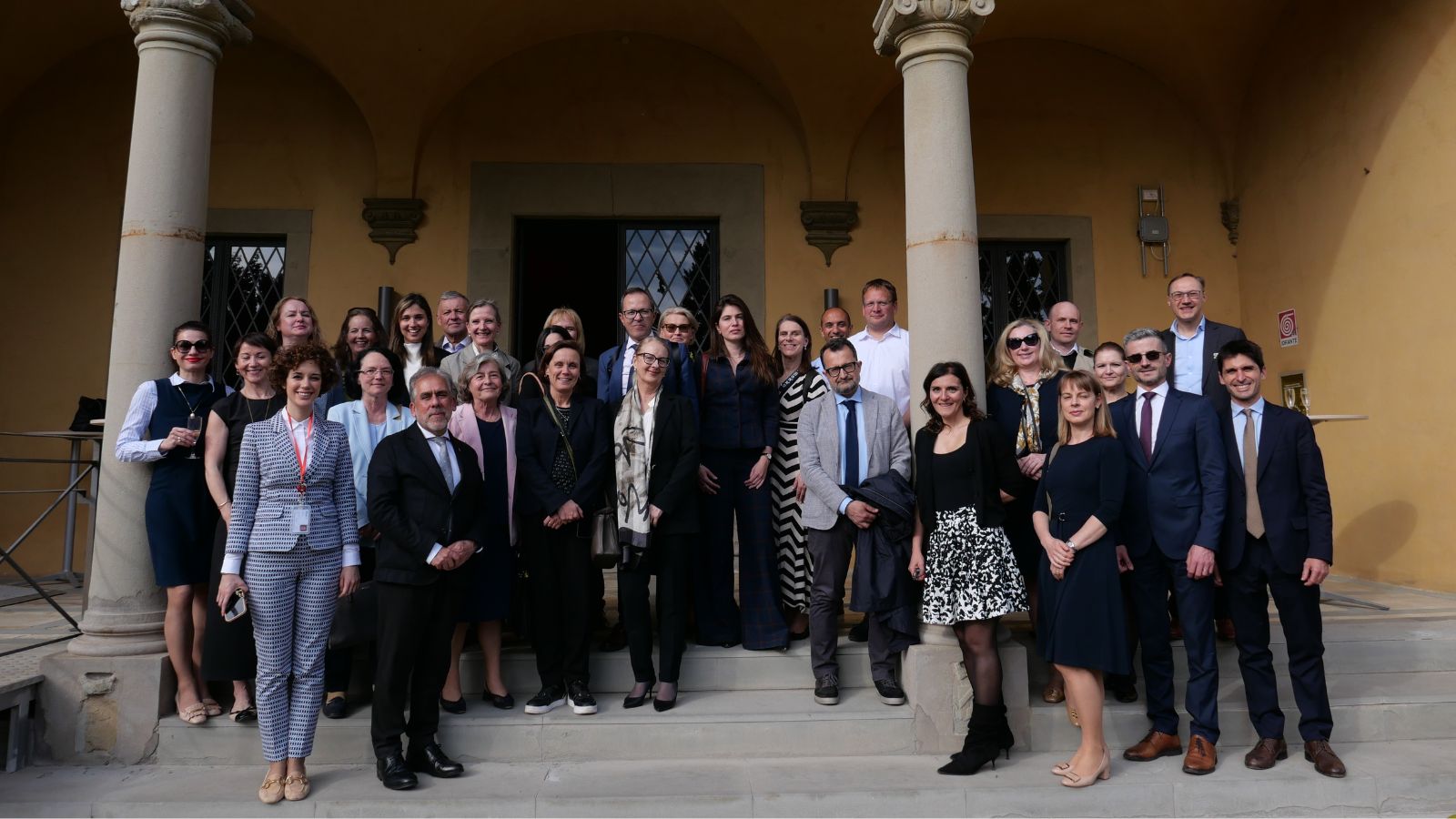
From 22 to 24 April 2026, the Centre for a Digital Society (CDS) at the European University Institute hosted the residential training of ENTraNCE for Judges 2026, bringing together thirty national judges from twenty-one EU Member States and Norway at Villa Schifanoia in Florence. Now in its fifteenth year, ENTraNCE is a multi-annual training programme for national judges in EU competition law, co-funded by DG Competition of the European Commission. This year’s edition focused on a particularly timely challenge: the interplay between EU competition law, the Digital Markets Act, and national regulation in digital markets.
Day 1 Competition Law and Economics in Digital Markets
The training opened with a keynote by Frédéric Jenny (ESSEC Business School / EUI), who set the intellectual tone for the three days. Jenny traced the structural features that make digital markets analytically distinct, multi-sided platforms, data economies of scale, network effects, and winner-takes-all tipping dynamics, while cautioning against deterministic conclusions. Historical examples, from Facebook’s displacement of MySpace to Instagram’s rise from a standing start, counsel against assuming that entrenched positions are permanent. But the tendencies towards ecosystem lock-in demand that courts engage seriously with economic evidence.
Pier Luigi Parcu and Niccolò Galli led the session on market definition, arguing that the 2024 Market Definition Notice represents modernisation, not rupture, and that dominance in digital markets is increasingly systemic, exercised through ecosystems and defaults rather than isolated product overlaps. They contrasted the Notice’s dynamic approach with the DMA’s deliberate bypass of traditional antitrust market definition through the gatekeeper designation regime, a contrast that does not displace the continued relevance of market definition in Articles 101 and 102 proceedings.
Anna Pisarkiewicz delivered a focused doctrinal journey from Bronner (1998) to the CJEU Grand Chamber’s ruling in Android Auto (2025), tracing how the “exceptional circumstances” test for refusal to supply has been recalibrated by digital platform markets. Recovering AG Jacobs’ three underlying concerns, property rights, dynamic investment incentives, and the administrability of access regimes, as the organising logic behind every subsequent derogation, she showed how Android Auto held that interoperability with a connected ecosystem service could be required without strictly satisfying all Bronner conditions. That Bronner’s 1998 dispute over a newspaper delivery network came to govern the API of a car dashboard illustrates the doctrinal journey EU competition law has undertaken in a generation.
Despoina Mantzari (UCL) examined judicial scrutiny of economic evidence, anchoring her analysis in ByteDance v Commission (Case T-1077/23), the first substantive judicial review of a DMA gatekeeper designation. The General Court rejected TikTok’s rebuttal, set a “high plausibility” threshold, and granted the Commission a broad margin of assessment. Mantzari drew out the problem of interpretive displacement, the DMA’s per se logic risking progressive displacement of the effects-based methodology of Articles 101 and 102, and the broken symmetry in the rebuttal mechanism, partially restored by ByteDance by allowing mixed evidence connected to quantitative criteria. She argued for a structured two-stage review distinguishing interpretive, application, and evidentiary questions, and posed the standard-of-review question that will be answered by the CJEU in C-627/24 P.
Day 2 Recent Enforcement Trends in Digital Markets
Giorgio Monti (EUI / Tilburg University) opened Thursday with a forensically rigorous session on exploitative abuses under Article 102(a) TFEU. The Phenytoin litigation, UK CMA decisions quashed twice, five expert economists in concurrent “hot tub” evidence, profit margins between 35% and 148%, illustrated the doctrine and its extraordinary procedural demands. Monti then turned to digital markets, examining Kent v Apple (CAT, 2025) on excessive commissions and the European Commission’s Apple App Store Article 102 decision finding anti-steering rules disproportionate to any legitimate monetisation objective. His methodological point: in platform markets an exploitative abuse on the P2B side can cause end-user harm without requiring proof of exclusionary foreclosure.
Luigi Malferrari (European Commission) provided the structural panorama of the DMA: its asymmetric designation regime; the distinction between Article 5 self-executing obligations and the specifiable obligations of Articles 6 and 7; and the Commission’s sole enforcement competence. His core message: the DMA and EU competition law are complementary but distinct, different legal bases, no market definition, no effects analysis, no efficiency defence. Courts encountering both regimes must navigate that architecture with care.
Marco Botta and Camilla Signoretta mapped DMA enforcement since March 2024. Seven gatekeepers are now designated across twenty-three core platform services. The two April 2025 non-compliance decisions, Apple App Store (€500 million, anti-steering) and Meta Consent or Pay (€200 million, absence of genuine free choice under Article 5(2)), were analysed in depth, alongside the April 2026 preliminary findings on Google’s search data sharing obligations. On DMA private enforcement, three landmark national rulings have established the field: OLG Köln (May 2025) dismissed an injunction against Meta’s AI training data use, reading Article 5(2) narrowly; LG Mainz (August 2025) granted an injunction against Gmail’s pre-installation on Android but applied the DMA to a non-designated service; and LG Frankfurt (September 2025) found no Article 6(5) violation in Google’s AI Overview placement. The divergence across these three rulings, and from the Commission’s own interpretations, underlines the urgency of the Article 39 cooperation architecture.
The afternoon combined a group exercise, built around live proceedings by eBay and Vinted against Meta’s Facebook Marketplace conduct before the Düsseldorf Higher Regional Court, raising parallel DMA and Article 102 claims after the Commission declined to open non-compliance investigations.
Day 3 the role of courts
Konstantina Bania (Brunel University of London) examined the challenges facing administrative courts reviewing NCA decisions in digital markets. Her framing was precise: too much deference risks unchecked regulatory error; too much intrusiveness risks paralysing enforcement. She identified five structural challenges (i.e., standard of review for technically complex records; competing expert models; forward-looking theories of tipping and entrenchment; proportionality review of novel and evolving remedies; and horizontal intersections with GDPR, consumer law and the DSA) before extending the analysis to DMA judicial review and warning that the first CJEU judgments on standard of review will set the tone for the entire regime.
Jens-Uwe Franck (University of Mannheim) closed the training with the full architecture of private enforcement against digital platform operators. On competition damages, he examined the Brand-gating and Filmwerkstatt Düsseldorfinjunction cases and the emerging Google Shopping follow-on jurisprudence, including the Berlin Regional Court’s €465 million award to Idealo and €107 million to Producto (both November 2025), whose comparative-market quantification methodology offers a replicable template for future claimants. On DMA private enforcement, Franck argued that private rights of action are both implicit and required: Articles 13(6), 39 and 42 DMA, read with the principles of sincere cooperation and effectiveness, compel Member States to provide adequate remedies. Competition damages law is the natural reference framework, as Germany’s GWB XI Amendment (Section 33) most clearly demonstrates.
Concluding reflections
Three cross-cutting themes emerged across the three days: the parallel-but-complementary relationship between EU competition law and the DMA, whose Article 39 cooperation architecture is being stress-tested in real time by the first national court rulings; the standard of review question, which recurred from ByteDance to Phenytoin to the Google Shopping damages awards; and the emerging private enforcement landscape, where national courts are already diverging from each other and from the Commission in the absence of procedural harmonisation.
Participants will continue through online activities before reconvening for the Final Workshop on 18–20 November 2026 at the EUI.
ENTraNCE for Judges is co-funded by DG Competition of the European Commission and organised by the Centre for a Digital Society (CDS) at the European University Institute. The scientific organisers of the 2026 edition are Pier Luigi Parcu, Marco Botta, Giorgio Monti and Niccolò Galli.